Showing posts with label AccuQuilt GO!. Show all posts

Friday, June 13, 2025

Windmill Weave by Sewspicious / Beauties Pageant 297

Here in Massachusetts, we are in the home stretch before summer vacation, and I am in all-out quilting mode. My younger son is wrapping up his last days of middle school, and I will be gifting his team of teachers and therapists quilts. This has proved to be an effective motivation for getting projects bound and off my WIP list!

One project that is headed to its forever home is Windmill Weave, a design by Vickeidy Plybon of Sewspicious. The plan for this project has been in the works for a few years, so I’m especially pleased to be able to share it with you today!

The Fabric

The pattern is written to accommodate a single cut of yardage or multiple fat quarters. I knew the two-color version I wanted to sew merited something other than my usual solids, so I cut into my stash of Cirrus Solids by Cloud9 Fabrics.

I bought these fabrics years ago ... They’re lovely, yard-dyed solids, with a texture that gives them more personality than the Bella Solids I usually work with.

Because their weave is looser than other quilting cottons and because I was using white as a background, I hand-washed and machine-dried all of my yardage. In fact, I even used Retayne, a color fixative, on the Amazon yardage, to prevent bleeding.

To be honest, I’m not sure how readily Cirrus Solids are anymore, but I’ve enjoyed the projects I’ve made with them and was happy I had them on hand for this project. (See my Quilt Buzz Bingo project for another example of how I have quilted with Cirrus Solids.)


The Pattern

I am always on the lookout for a cleverly written pattern, and Windmill Weave did not disappoint! If you’re a partial-seam fraidy cat, you can construct the blocks without sewing a single partial seam. I, however, followed a supplementary blog post and sewed all nine of my blocks with partial seams. 

Truly, they’re no big deal! My only words of warning for you are these: For the partial-seam approach with the square throw, I needed to sew 18 strip sets instead of 15. You could buy more yardage to accomplish this, but I chose to get creative with how I cut my yardage. Some of the necessary strips were cut width of fabric; others were cut along the length. In the end, I’m not sure exactly how much foreground fabric I used (I had already used a bit in this quilt). If you follow in my footsteps and sew this pattern with partial seams, be sure to do all the math up front to ensure you have enough fabric on hand.

The Quilting and Binding

I was at a loss for how to quilt this top. I knew I didn’t want to quilt it myself because I thought Windmill Weave’s strong geometry, with all those horizontal and vertical lines, would benefit from something softer and swirly-er than my straight-line quilting.

Taking a cue from the backing, I selected a panto with a circular pattern ...

I considered many different scenarios for the binding. (Doesn’t it seem as if the binding can make or break a project?!) I decided that the binding fabric should either be overstated (think: lime green!) or understated (think: white!). In the end, chose the understated option: I had a light gray in my stash that played off the light gray quilting thread.

Windmill Weave was an enjoyable make. I got to use my AccuQuilt Go to cut out all those skinny strips, streamlined the quilt-making process with strip sets as directed in the pattern, and busted through long-stashed yardage in the process. I might have another Windmill Weave in me. I think I would have fun with a second go by using multiple foreground fabrics.  : )

Follow Me On ...  


* * *


The pageant rules are simple:
  • Post your finish in the linky tool. (No links to your own giveaway or linky, please!)
  • Point your readers back here with a text link or use the button above.
  • Visit and comment on other participants’ finishes.

You are invited to the Inlinkz link party!

Click here to enter

Friday, February 28, 2025

Knot and Thread's All the Things Tote / Beauties Pageant 284


The past few days have been all about re-entering life as usual after an amazing QuiltCon in Phoenix. I had the best time at the conference, looking at quilty works of art, reconnecting with faraway friends in person, enjoying so much good food, and doing my fair share of shopping.

The All the Things Tote that I talked about in my last post was with me every step of the way. The pattern, by Knot and Thread, provides instructions for three sizes. I made the large one, skipping the suggested sturdy base, which I thought might be cumbersome on the plane and in the convention center.

I can’t say enough about this pattern. The adjective that I keep using to describe it is “slick.” I was a bag maker before I was a quilter, and I’ve sewn some elaborate bags. This is not one of them. I am confident that a quilter who’s embarking on a first bag project could get great results with this pattern.

The instructions are geared toward yardage, with a workaround if you’re sewing with a directional fabric. Of course, I complicated the situation by piecing my exterior panels with blocks from my upcoming book. It was 100% worth it! The bag was a great conversation starter as I walked the show floor last week, and everyone who commented on it was rewarded with a sticker sheet featuring other blocks from the book.

The pattern calls for machine sewing every step of the bag-making process, and I did that up until I had to finish the binding on each end of the bag. I knew I wouldn’t be able to top-stitch through that bulk as neatly as I wanted to, so I used a 12 weight Aurifil thread to hand-sew a chunky stitch on that section of the binding. I’m calling this decision the “the path of least swearing”!


All of the fabric selections are from Ruby Star Society except for the Bella Solid I chose as the lining. I particularly love the black Starry featured on the binding. If you take a peek in the pockets, though, you’ll see that I also used the small-scale white Starry. I went with the white Starry here mainly because I didn’t have enough of the Bella Solid for the pocket linings. I love the juxtaposition of the two Starry fabrics, though, so let’s call it a design decision!


If you’ve made an All the Things Tote, I want to see it! Link it, along with your other finishes, in the linky below!

You can preorder my book here!

 
Even if you weren’t at conference, you can take advantage of my QuiltCon special: Preorder the book, and receive 2 PDF patterns free right now.
 
The preorder listing includes these instructions: To get the free patterns, add the book preorder to your cart. Then, navigating to the PDF Patterns page, add 2 PDF patterns to your cart. (You must add 2.) Upon checkout, use the discount QUILTCON.

Your patterns will be available for immediate download from an email that youll receive momentarily (check your spam folder if it doesn’t appear in your inbox after a few minutes). The book is slated to ship at the end of April 2025 via USPS.


* * * 

Quilters outside of the US: The cost of international shipping is ridiculous! As a result, this preorder is limited to US mailing addresses. Just because you live elsewhere on this planet, however, doesn’t mean you should miss out! Drop me a note (frombolttobeauty@gmail.com) after preordering or purchasing the book locally, and I will hook you up with your free patterns. : )


Follow Me On ...  


* * *


The pageant rules are simple:
  • Post your finish in the linky tool. (No links to your own giveaway or linky, please!)
  • Point your readers back here with a text link or use the button above.
  • Visit and comment on other participants’ finishes.

You are invited to the Inlinkz link party!

Click here to enter

Friday, January 10, 2025

Use It or Lose It: Cirrus Solids / Beauties Pageant 279

My love affair with Cirrus Solids started back in 2021 when I made my Quilt Buzz Bingo project. I wanted a special solid to sash my blocks, and these yarn-dyed wovens are a little heavier than—and have more personality than—regular quilting cottons.

The color and texture of Cirrus Solids in Ocean, a deep blue, transformed my blocks. Without it, my pink and green blocks looked very “modern Christmas.” The sashing erased all evidence of the holidays and replaced it with “preppy summer.” The palette makes me think of a woven button-down shirt and cutoffs, and the finished quilt is on my bed right now in an effort to inject color into my New England winter.

Ocean wasn’t the only Cirrus Solid in my stash, however: When I reorganized my stash recently, I realized I had 3-plus yards of both Limestone (a white) and Amazon (an aqua). It was time to find those beauties a purpose!

Enter Windmill Weave by Sewspicious. Although there’s something special about mixing Cirrus Solids with quilting cottons, as I did in Quilt Buzz Bingo, there’s something equally special about using solely Cirrus Solids, and I know this bold, graphic design will be striking sewn up in Limestone and Amazon.

I am two blocks into this project. Thanks to my AccuQuilt Go and strip piecing, however, the process is surprisingly fast. I have more to say about using Cirrus Solids and the pattern, but I’ll save those comments for a future update on my progress. : )

Follow Me On ...  


* * *


The pageant rules are simple:
  • Post your finish in the linky tool. (No links to your own giveaway or linky, please!)
  • Point your readers back here with a text link or use the button above.
  • Visit and comment on other participants’ finishes.

You are invited to the Inlinkz link party!

Click here to enter

Friday, May 24, 2024

The Scrappiest Stars / Beauties Pageant 252

Over the past few weeks, Ive been addressing the mountain of scraps in my house. It has been a big time suck, but I see the light at the end of the fabric-y tunnel.

Part of this process has involved putting some scraps to use right away, and Ive cut maybe a half-dozen projects. Has doing so complicated my efforts? Yes, it most certainly has. But if Im going to be touching almost every piece of fabric I own in an attempt to organize it, I might as well pull fabric for some projects.

The scrappiest of those projects is Quilty Stars, a pattern by Emily Dennis and the first of hers that Ive sewn. (Can that be right? Ive never made one of her patterns before?) Its a little outside of my comfort zone because its just so very scrappy. I think a more Michelle approach would have been to make two quilts, one with solid stars and a scrappy background and one with scrappy stars and a solid background, but its too late to change course now.

While organizing my scraps and sewing this project, I realized that my pattern library isnt as orderly as I had thought. I purchased the PDF of Quilty Stars only to find a printed copy in my stash, so this post has turned into an impromptu giveaway ...

If you would like this printed pattern to make your own scrap-tastic Quilty Stars, let me know in the comments. If more than one person is interested, Ill pick a name at the end of Sunday, May 26. Im happy to mail this pattern anywhere in the world. If you’re a no-reply blogger or comment anonymously, please include your email address in your comment or send it to me at frombolttobeauty (at) gmail (dot) com.

Follow Me On ...


* * *


The pageant rules are simple:
  • Post your finish in the linky tool. (No links to your own giveaway or linky, please!)
  • Point your readers back here with a text link or use the button above.
  • Visit and comment on other participants’ finishes.

You are invited to the Inlinkz link party!

Click here to enter

Friday, October 23, 2020

A Notion Giveaway / Beauties Pageant 102

Back in the late spring and early summer, I did a thorough excavation of my stash. I picked up every piece of fabric that was a fat quarter or larger. Those prints that I still wanted to use went back in my storage drawers; those that didn’t were sold on FeelGood Fibers. (To date, I’ve sold more than $400 of fabric to the FGF community!)

I thought I was done. After all, I moved out a bunch of material that was no longer working for me, making the space and earning the money to buy quilting cotton that excited me. Then FGF launched its Declutter to Destash initiative, and I realized I still had work to do.

This challenge is all about getting rid of—by selling, donating, or trashing—what you don’t need and organizing what you want to hold on to. I started small and evaluated my notions. I consolidated my needles, tossed old seam rippers and marking tools at the end of their lives, and set aside duplicate items or notions I don’t use. The whole process took less than an hour.

Then I moved on to my scraps, which lived in resealable bags that I stored in a big plastic bin. Everything was already sorted by color, so really, what more did I have to do?

So much more.

I started by pulling scraps and cutting them for two projects: Plaid-ish by Erica Jackman and Brightly by Allison Harris. Then I went back through each bag. Fabrics that I had no interest in using were set aside for selling on FGF (see my popup shop here). Pieces smaller than 2.5 inches went in the recycling pile (my town recycles textiles). Larger pieces were ironed and placed in a new scrap drawer. The stuff in between was cut into hundreds of 2.5-inch squares (see picture at the top of the post). I have my eyes set on Jessie Fincham’s Scrappy Irish Chain tutorial, which requires almost a thousand 2.5-inch squares, to use up that collection.

The survey of my scraps took a good week and a half. It consumed all my crafty time (I did no sewing while I worked on it), and I found the process overwhelming at times. I employed the use of my AccuQuilt Go! to transform oddly shaped scraps into pretty 2.5-inch squares. Doing so made the process go faster.

Now I have a humble collection of notions—what’s pictured below as well as items that didn’t make it in the shot—that I’d love to pass on to someone who will use them. If that someone is you and you live in the United States, let me know in the comments below, and the lot is all yours. (If you’re a no-reply blogger, please leave your email address; otherwise, I have no way of contacting you.) First come, first served! This collection of notions has already been sent to its new owner. : )


Follow Me On ...


* * *


The pageant rules are simple:
  • Post your finish in the linky tool. (No links to your own giveaway or linky, please!)
  • Point your readers back here with a text link or use the button above.
  • Visit and comment on other participants’ finishes.

You are invited to the Inlinkz link party!

Click here to enter

Tuesday, June 20, 2017

Technique: How I Machine-Piece Hexagons

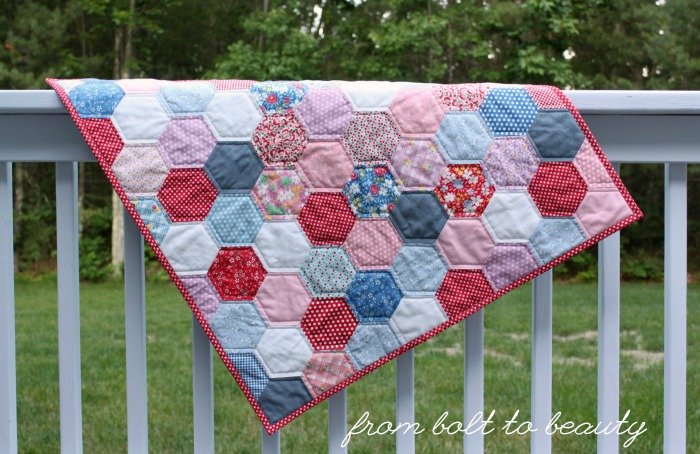
To read more about the finished hexagon quilt, click here.

Earlier this year, I dispelled the myth that partial seams are something to avoid. As it turns out, they’re downright easy. So I was thinking, could the same be said of the dreaded Y-seam?

To see whether I could conquer this technique, I decided to make a baby quilt out of hexagons. I consulted a few tutorials, cut my hexagons, and went for it. After machine-piecing a dozen hexagons or so, I ripped out each seam and started all over again. : (

I decided that if I had more information upfront, with more pictures, I could have saved myself the hassle. Perhaps you learn that way, too? If so, here’s how I pieced my first-ever hexagon quilt, with Y-seams that I’m proud of!

Cut the Hexagons Accurately


I have an AccuQuilt Go! If you’re sewing with hexagons, you do not need a fabric-cutting machine, but since I already owned one, I decided to invest in a hexagon die for this project. This die cuts hexagons in three sizes, and I cut my fabric with the largest of those, the 5-inch hexagon. (I think the smaller sizes would have been too fiddly to work with.)

Alternatively, I could have cut the hexagons with a specialized ruler (like the Hex N More) or have bought precut hexagons.

Make a Template and Mark the Hexagons


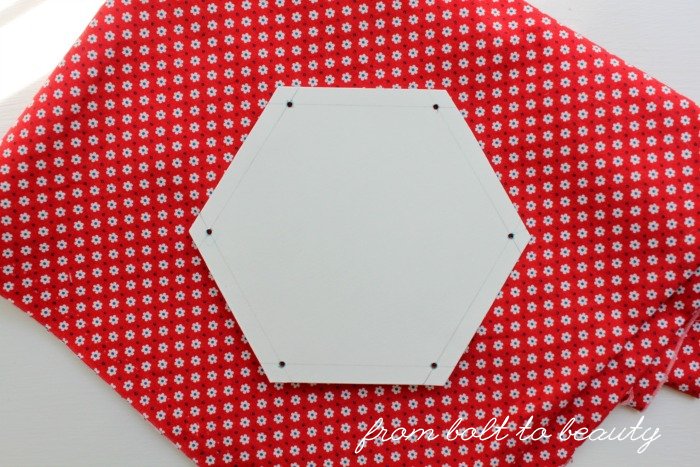
I made a template for marking my hexagons by running a piece of cardstock through my AccuQuilt GO! (I wouldn’t make a habit of cutting paper with my machine, but I figured doing it once in a while wouldn’t dull the die.) It is the same size as the fabric hexagons I cut. If you hand-cut your hexagons or bought precuts, you could do the same by tracing one of your hexagons onto cardstock and cutting it out.

After you have your cardstock template, draw lines a quarter of an inch from each side and punch a hole at the intersections of those lines. (I used a 1/16-inch hole punch to do that.)


Then, using this template and a pencil, mark the six intersections on the wrong side of each hexagon.

Sew the Hexagons in Group of Threes


The instructions I consulted recommended laying out the hexagons, sewing the hexagons into columns, and then sewing the columns together. I had better luck, however, sewing my hexagons into groups of threes and then sewing those trios to others.

When I’m working with groups of threes, I can consistently sew a nice Y-seam. When I add a group of three to another group of three, I still have good control and produce a beautiful Y-seam. On the other hand, when I’m working with columns, I’m always working with big, awkward chunks of fabric, and it’s harder to get my seams as precise as I would like.

Here’s how to sew these trios together, one seam at a time ...

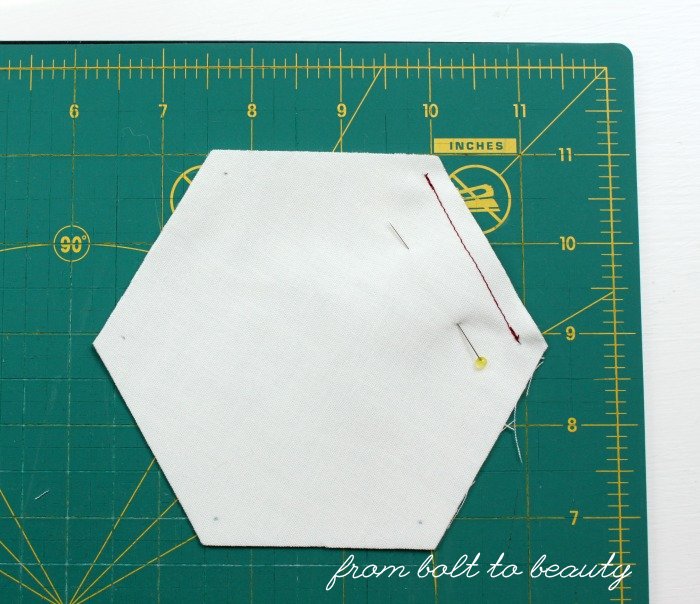
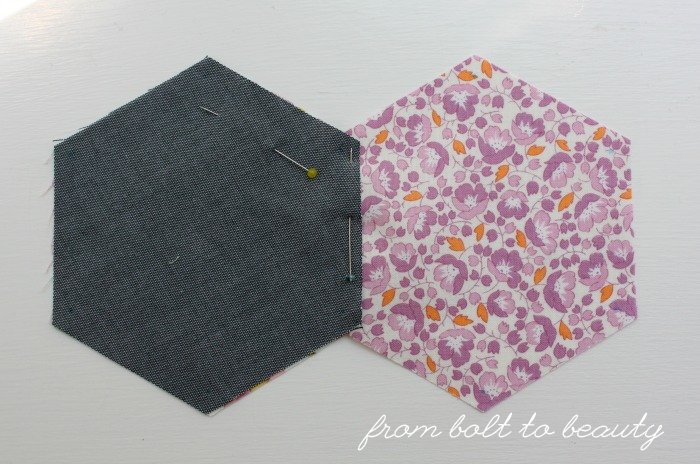
1. After deciding on the layout for your hexagons, sew two adjacent ones together. This entails matching the corners of the hexagons, right sides together, and sewing from one mark to the other on the edges you want to join. Note: If you sew beyond one of your marks, you’ll be sewing into the seam allowance, which can cause unpleasant puckers on your quilt top. Also: Sewing hexagons requires sewing on the bias a lot—be careful not to pull or distort those bias edges as you sew them.

Check out this example that uses dark red thread to show where the seam starts and stops. I used my hand wheel to start precisely on the pencil mark, and I pinned the two hexagons together before sewing. I also backstitched at the beginning and ending of the row of stitches.


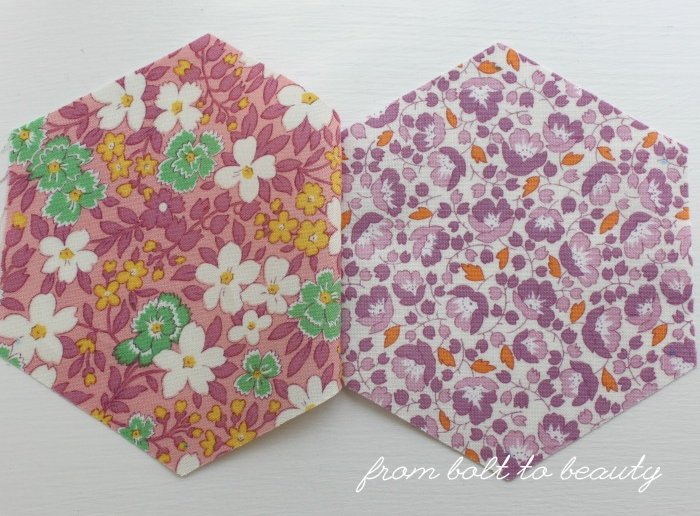
When you’re done with your seam, don’t press it. Your two hexagons (now shown in my fabric of choice for this project) will look like this …


2. Match the corners of the third hexagon with one of the first two hexagons, right sides together.


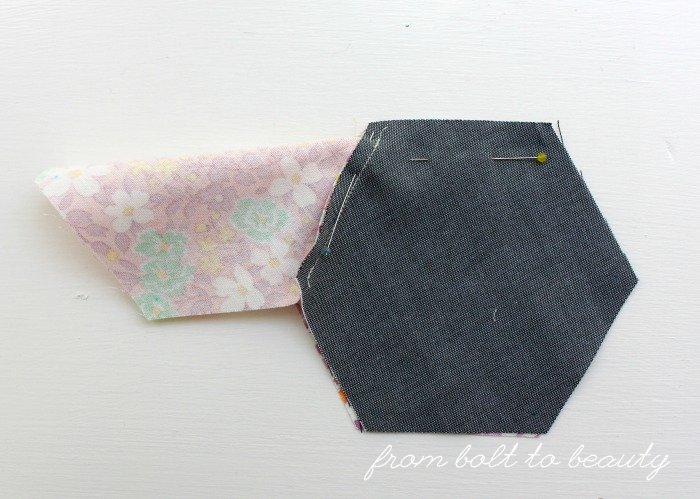
3. Finger-press the first seam out of your way, so you don’t catch it in the seam you’re about to sew.


4. Use two pins, one along the seam you will be sewing and one along the seam allowance you want to avoid sewing into.


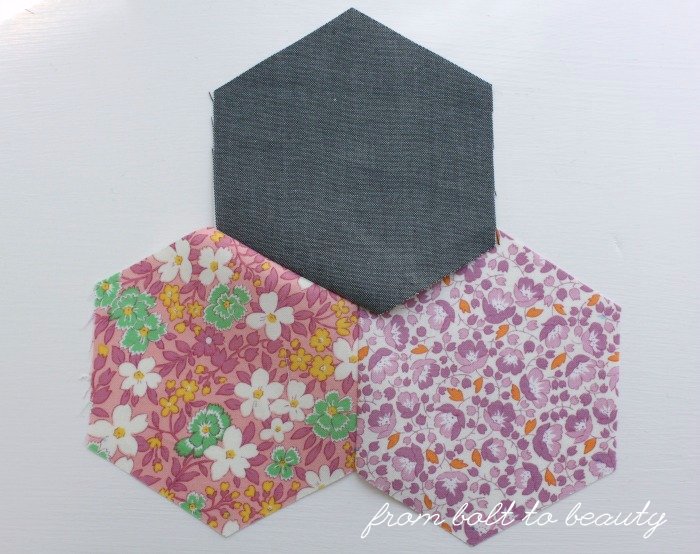
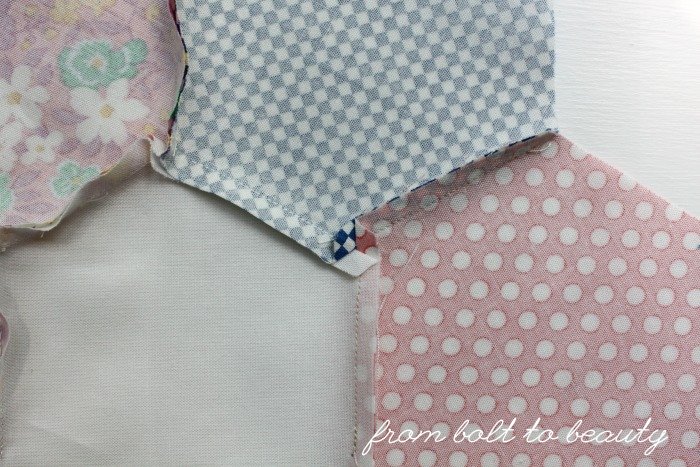
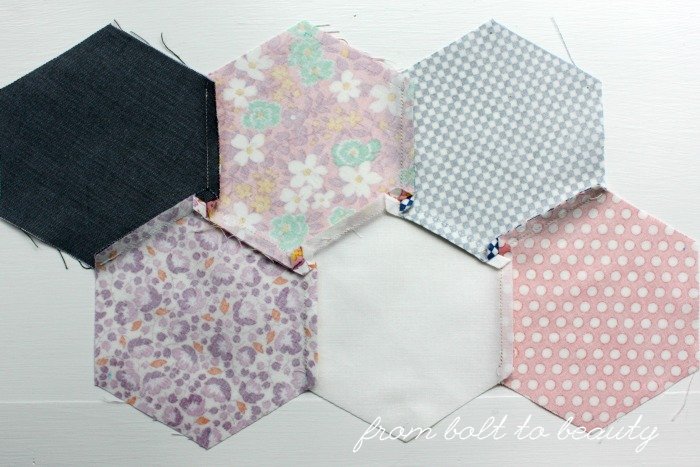
5. Sew the second seam—again, sewing from one mark to the other and not pressing the seam when you’re done. Now your trio will look like this ...


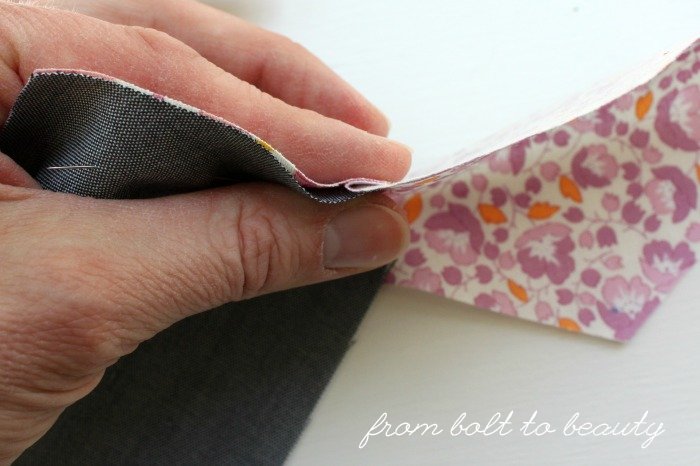
6. The final seam is sewn exactly like the second one. Pin as needed to avoid sewing through a seam allowance. You can see how I fold my fabric, finger-pressing my seams as I go, to get those seams out of the way ...


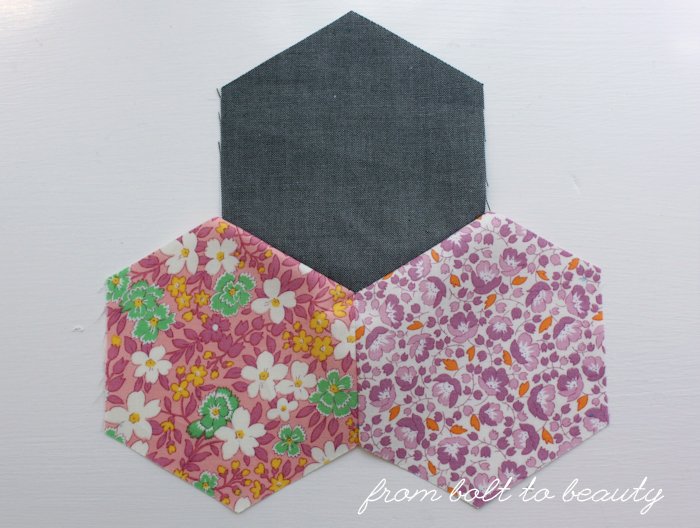
7. Your finished trio of hexagons will look like this. Please note: I pressed my seams for the sake of the picture, but it’s best to wait until later to press. (Update: With the second quilt I made using this tutorial, I didn’t wait to press my seams, and when I did press them, I pressed them open. Everything worked out just fine with that method. Choose whichever way makes you happiest!)


Sew Your Groups of Three Together


You’ll follow the same principles to sew two trios together ...

Sew one seam at a time, without pressing the seams, and pin as necessary to avoid those seam allowances.


Piece the Top in Chunks


Even though you’re sewing manageable trios instead of columns, at some point you will need to deal with large swaths of hexagons.

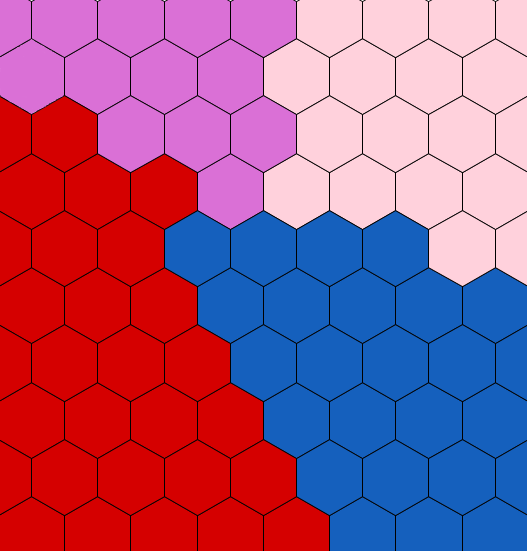
My hexagon project was a small baby quilt, about 31 inches square, and I opted to sew the quilt in quadrants and then sew those quadrants together. There was nothing precise about how I divided up the blocks, though. I just kept sewing until all my groups of three (or random singles, because there were a few of those by the end) were used up. My sections ended up looking pretty random, more like blobs than quadrants ...


Divide up your quilt top in whatever way works for you. It may help to take a few pictures of your layout with your phone. That reference will ensure you don’t sew anything incorrectly!

Press Your Seams


At this stage, you can press your seams. (See my update, above, for an alternative approach.) Start with the intersection of any trio of hexagons, and press the seams to one side. In the picture below, I pressed the seams counterclockwise around the intersection, but I could have just as easily pressed them clockwise.


The way that first intersection is pressed affects the intersections adjacent to it, as you can see in the next picture. The two top intersections are pressed clockwise, and the bottom two are pressed counterclockwise.


Remember that you are working with many bias edges. Try not to distort the fabric as you press.

Continue until you have pressed the entire quilt top. 

Finish Your Quilt


With all the seams press, you can trim your quilt top and complete your project.


I think the key to a positive hexagon-piecing experience is patience and precision. Start small, with a baby quilt like I made, to see whether machine-piecing hexagons is for you. If you give the technique a shot and have any thoughts on fine-tuning the process, please share in the comments. Thanks!

To read more about the finished hexagon quilt, click here.

Linking up to Let’s Bee Social, Needle and Thread Thursday, Tips and Tutorials Tuesday, and Finish It Up Friday ... 

Follow on Bloglovin